
(vegan Italian Easter bread)
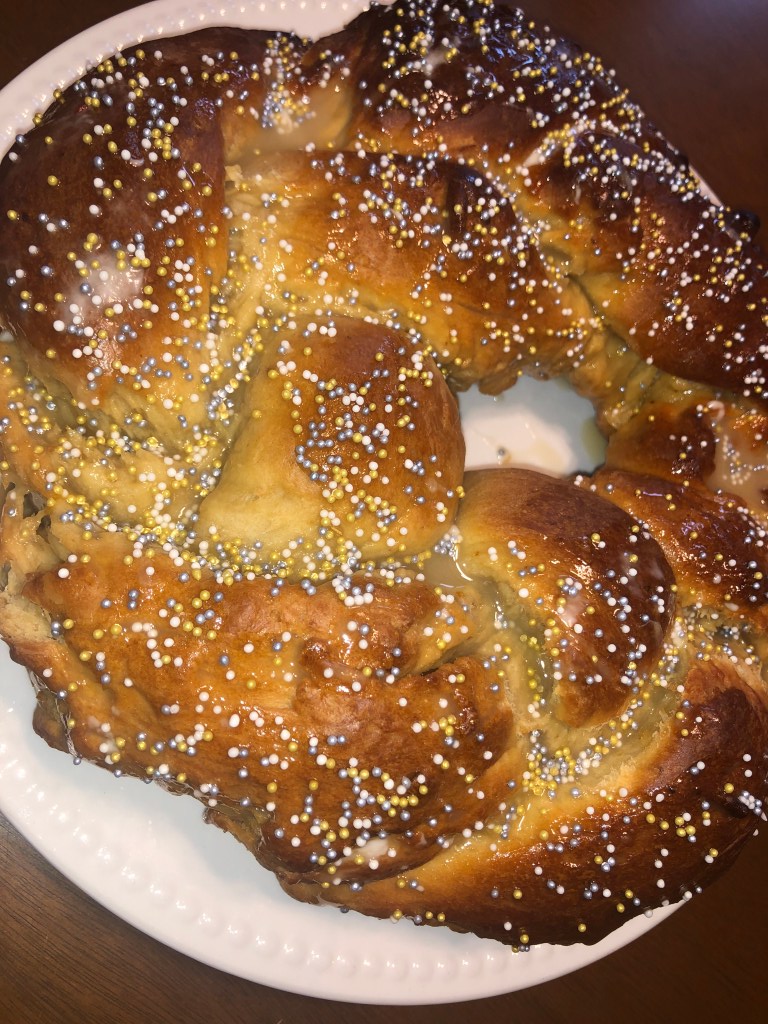
I’ve mentioned before that I’m the child of an Italian immigrant. One of the traditions that my family brought from Italy is pane di Pasqua, or Easter bread. Flavored with anise, this traditionally eggy bread has a dense, dry crumb and is not too sweet… but it’s delicious. My aunts would braid dyed eggs into the loaf before baking, which I always considered a perfectly good waste of the bread parts because who would want to peel delicious bread off of an egg? I sure didn’t! Things my 8-year-old brain struggled to understand.
A couple of years ago I undertook the task of veganizing pane di Pasqua. Garrett also grew up with this bread (he’s Italian on his dad’s mom’s side), and G is vegan. There were many iterations of this bread before we settled on the final loaf; it turns out it was rather difficult to remove 5-6 eggs from the original recipe and have the same consistency in the end, but we did it! Kala namak, or black salt (which is actually pinkish), lends an eggy flavor and aquafaba steps in to provide the structure and binding properties that eggs are known for. It turns out we didn’t have to put in a ton of aquafaba or black salt for the eggs.
One thing you will notice while you’re making this is that it doesn’t rise like a traditional loaf of bread. Due to the addition of the sugar and extract, the yeast activity is quite a bit more leisurely than you might be used to. During the initial rise, the dough will “puff up” but not really spread to fill the form of the bowl that it’s in. I give it a solid three hours in a cold oven with the oven light turned on, which will provide the perfect amount of heat to rise.
For those of you not familiar with Italian pastry, they’re not usually as sweet as their American counterparts. This follows the subtle sweetness and slight dryness of the traditional bread, as it is meant to be eaten with a hot cup of coffee or espresso. I hope you enjoy this bread as much as we do. Buona Pasqua!
Vegan Pane di Pasqua (Italian Easter Bread)

Traditionally baked at Easter time, this slightly sweetened anise bread is delicious for breakfast or anytime as a snack with a steaming cup of tea or espresso
- Stand Mixer
- Baking Sheet
- Sheet Parchment Paper
For the Bread
- ½ cup plant milk, unsweetened
- ½ cup sugar
- ⅓ cup aquafaba ((literally "bean water" drained from a can of chickpeas))
- 2 whole oranges, zested and juiced, divided (see note) (zest the oranges, then slice them in half and squeeze the juice out of them; reserve half the juice for the icing.)
- 1 tbsp yeast
- ½ cup vegan stick butter, melted
- ½ tsp black salt (also called kala namak)
- ¾ tsp kosher salt
- 1 tsp anise extract
- 4½ cups all purpose flour
For the Icing
- 1 cup organic confectioner's sugar
- 1 tbsp reserved orange juice from above recipe
- 1 tbsp plant milk
- ½ tsp anise extract
- multicolored nonpariels (optional)
For the Bread
In the bowl of a stand mixer fitted with a dough hook, add the sugar, aquafaba, plant milk, orange zest, half of the orange juice, and the yeast. Turn on low until combined. Allow to sit for 5-10 minutes.
In a separate bowl, mix 4 cups of flour and the salt.
Add anise extract to the melted butter.
With the mixer on low, slowly add the flour, ½ cup at a time alternating with the butter until everything is incorporated.
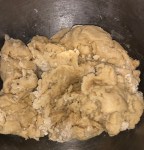
Mix on medium for 5 minutes, checking after 2 minutes. The sides of the bowl should be clean. If they are not, add remaining flour 2 Tbsp at a time, mixing for 1 minute after each addition. At the end of 5 minutes, the dough should be slightly tacky and the sides of the bowl should be clean but the dough can be stuck to the very bottom of the bowl.
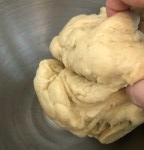
Scrape the dough out into a large greased bowl (I rub the inside of the bowl with an oiled paper towel). Cover and allow to rise until it increases in size by half to double. This takes a while! Depending on the warmth of your kitchen, it can take anywhere from 2-3 hours. This doesn't look like your "usual" bread rise; it doesn't really flatten out and get very bubbly, but it will have a "puffed" appearance and will appear larger.
When dough is increased in size as above, punch dough down.
Prepare a baking sheet with a single layer of parchment paper.
Divide dough into 3 equal parts. Roll each into approximately an 18 inch rope on a lightly floured surface. Braid the ropes and fashion the braid into a circular loaf on the parchment lined baking sheet.
Cover loosely with a tea towel and allow to rise for 45 minutes, and it will appear increased in size.
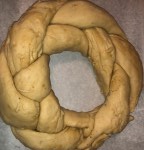
Set the oven rack to the middle of the oven. Preheat the oven to 350°F.
Bake 30-45 minutes until golden.
Cool completely on the baking sheet.
For the Icing:
Mix the confectioner sugar, plant milk, anise extract and 1 Tbsp of the orange juice. The icing should be thick but runny consistency. Add additional orange juice until the consistency is that of a thick glaze.
Pour icing over the bread, allowing it to slowly drip down the sides.
Sprinkle with colored nonpareils, if using.
This bread is traditionally on the dry side as it is supposed to be served with coffee, though it is equally delicious with some cream tea. Leftovers should be well wrapped and kept at room temperature. When we were kids, we’d eat any stale leftovers with milk, like a bowl of cereal!
 bigmuddyorchard.com